Artist Statement
Charles Bouvialaa.k.a. Moez
I have never been able to say where I come from in a single sentence. French, Muslim, trained in the fine arts, raised on street art: it takes several pieces, and something is still missing. I eventually understood that this in-between space was not a problem to be solved. It is where I paint from.
It all began with a transgression. In 1999, I am twenty, studying at an art school, and I repaint my First Communion alb in black, with a sun on the chest. An instinctive gesture, with no intent behind it. The moment I finish, everything tips over: a heavy dread sets in and lasts for months. I look for comfort in the Bible and don’t find it. One evening, I open the Qur’an again and read it aloud, two nights in a row. Something eases. On March 4, 2000, I become a Muslim.
Since then, I have gotten rid of most of my earlier work, and I have decided to dedicate my work to my Creator. A work leaves a trace and binds the one who makes it. There is an expression, sadaqa jariya, ongoing charity: what keeps being useful after we are gone. I would like my work to be of that kind, a little good that lasts, and not noise.
As a child, I looked at the letters on walls before I knew what art was. Near my home, the graffiti artist André Saraiva had covered a façade with long sentences. I would stand there in front of it, not understanding, unable to leave. That is where I learned that writing could live outdoors, breathe, pulse.
Later, Arabic calligraphy gave me a structure. In Senegal, I discovered sub-Saharan calligraphy, and a country where art is everywhere: on the minibuses known as cars rapides, on the boats, on the walls. I understood that something can be graphic, popular, and sacred without one damaging the other.
Basquiat taught me the nervous energy of writing, Ben Vautier self-mockery, Duchamp that an everyday object can carry a thought.
My work bothers people on both sides. At university, one professor accused me of being monomaniacal; an instructor told me, “But sir, you’re not Arab.” In 2020, a canvas of the first fourteen verses of Surah Ta-Ha, shown in a Facebook group of Muslim business owners, earned me accusations of sorcery and hostile private messages, with copy-pasted religious opinions arguing that verses should not be hung on a wall. The post was taken down. A scholar I consulted saw nothing problematic in it.
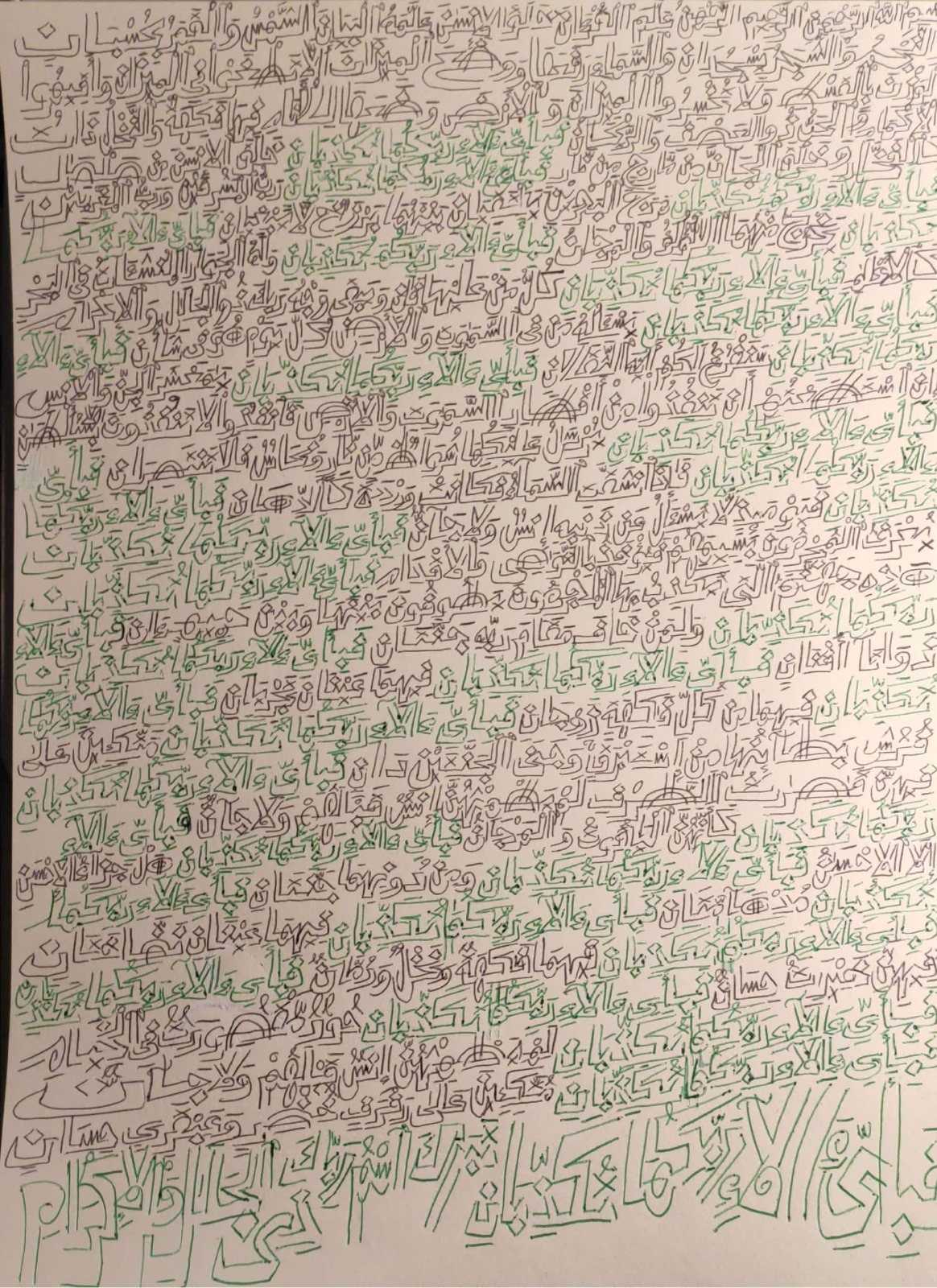
I write in Arabic: formulas of dhikr, verses, supplications, hadiths. Since the point is to deliver a message, I often pair them with a translation, in French or English depending on the piece. On paper, canvas, or found objects, with markers, felt-tips, spray paint, correction fluid, I let the writing and the material rub against each other directly.
I bring the expression of the divine message up to date for our time. The ready-made helps me do it: by inscribing the message on an everyday object, I anchor it in reality and give it new life. A precision laboratory balance thus carries verses 7 and 8 of Surah 99, on the weight of an atom of good or of evil, in French on strips, in Arabic in white paint on the pans and the drawer. I call this, in quotation marks, “artistic preaching.”